Thursday, November 8, 2012

DEEPAVALI


The history of Diwali is replete with legends and these legends are moored to the stories of Hindu religious scriptures, mostly the Puranas. Though the central theme of all legends point out to the classic truth of the victory of the good over the evils, the mode of their presentation and the characters differ. Diwali, being the festival of lights, lighting the lamp of knowledge within us means to understand and reflect upon the significant purpose of each of the five days of festivities and to bring those thoughts in to the day to day lives.

The five day of Diwali
The first day of Diwali is called Dhanvantari Triodasi or Dhanwantari Triodasi also called Dhan Theras. The second day of Diwali is called Narak Chaturdasi. It is the fourteenth lunar day (thithi) of the dark forthnight of the month of Kartik and the eve of Diwali. On this day Lord Krishna destroyed the demon Narakasur and made the world free from fear. The third day of Diwali is the actual Diwali. This is the day when worship for Mother Lakshmi is performed. On the fourth day of Diwali, Goverdhan Pooja is performed. The fifth day of the diwali is called Bhratri Dooj. It is a day dedicated to sisters.

Hindu Mythology
The Story of Rama and Sita: Lord Rama was a great warrior King who was exiled by his father Dashratha, the King of Ayodhya, along with his wife Sita and his younger brother Lakshman, on his wife's insistence. Lord Rama returned to his Kingdom Ayodhya after 14 years of exile, in which he put an end to the demon Ravana of Lanka, who was a great Pundit, highly learned but still evil dominated his mind. After this victory of Good over Evil, Rama returned to Ayodhya. In Ayodhya, the people welcomed them by lighting rows of clay lamps. So, it is an occasion in honor of Rama's victory over Ravana; of Truth's victory over Evil.

The Story of King Bali and Vamana Avatar(the Dwarf): The other story concerns King Bali, who was a generous ruler. But he was also very ambitious. Some of the Gods pleaded Vishnu to check King Bali's power. Vishnu came to earth in the form of a Vamana(dwarf) dressed as priest. The dwarf approached King Bali and said "You are the ruler of the three worlds: the Earth, the world above the skies and the underworld. Would you give me the space that I could cover with three strides?" King Bali laughed. Surely a dwarf could not cover much ground, thought the King, who agreed to dwarf's request. At this point, the dwarf changed into Vishnu and his three strides covered the Earth, the Skies and the whole Universe! King Bali was send to the underworld. As part of Diwali celebrations, some Hindus remember King Bali.

The Defeat of Narkasur by Lord Krishna: Lord Vishnu in his 8th incarnation as Krishna destroyed the demon Narkasura, who was causing great unhappiness amongst the people of the world. Narkasura was believed to be a demon of filth, covered in dirt. He used to kidnap beautiful young women and force them to live with him. Eventually, their cries for rescue were heard by Vishnu, who came in the form of Krishna. First, Krishna had to fight with a five-headed monster who guarded the demon's home. Narkasura hoped that his death might bring joy to others. Krishna granted his request and the women were freed. For Hindus, this story is a reminder that good can still come out of evil.

Krishna and The Mountain: In the village of Gokula, many years ago, the people prayed to the God Indra. They believed that Indra sent the rains, which made their crops, grow. But Krishna came along and persuaded the people to worship the mountain Govardhan, because the mountain and the land around it were fertile. This did not please Indra. He sent thunder and torrential rain down on the village. The people cried to Krishna to help. Krishna saved the villagers by lifting the top of the mountain with his finger. The offering of food to God on this day of Diwali is a reminder to Hindus of the importance of food and it is a time for being thankful to God for the bounty of nature


HAPPY DEEPAVALI TO ALL

When you Pray with true heart, u r prayers will be answered

A little boy about 10 years old was standing before a shoe store on the roadway, barefooted, peering through the window, and shivering with cold. A lady approached the boy and said, “My little fellow, why are you looking so earnestly in that window?” “I was asking God to give me a pair of shoes,” was the boy’s reply.
The lady took him by the hand and went into the store and asked the clerk to get half a dozen pairs of socks for the boy. She then asked if he could give her a basin of water and a towel. He quickly brought them to her. She took the little fellow to the back part of the store and, removing her gloves, knelt down, washed his little feet, and dried them with a towel.
By this time the clerk had returned with the socks. Placing a pair upon the boy’s feet, she purchased him a pair of shoes. She tied up the remaining pairs of socks and gave them to him. She patted him on the head and said, “No doubt, my little fellow, you feel more comfortable now?”
As she turned to go, the astonished lad caught her by the hand, and looking up in her face, with tears his eyes, answered the question with these words: “Are you God’s Wife?”

When you Pray with true heart u r prayers will be answered

Thursday, November 1, 2012

Bring light to the ignorant and bring more light to the intelligent..

Swami Vivekananda was having a long trek in the Himalayas when he found an old man extremely exhausted standing hopelessly at the foot of an upward slope. The man said to Swami Vivekananda in frustration, ‘Oh, Sir, how to cross it; I cannot walk any more; my chest will break.’
Vivekananda listened to the old man patiently and then said, ‘Look down at your feet. The road that is under your feet is the road that you have passed over and is the same road that you see before you; it will soon be under your feet.’ These words emboldened the old man to resume his onward trek.


Bring light to the ignorant and bring more light to the intelligent..

Tuesday, October 30, 2012

ಕನ್ನಡ ರಾಜ್ಯೋತ್ಸವ

About Kannada Rajyotasava

Aluru Venkata Rao was the first person who dreamt of unifying the State as early as 1905 with the Karnataka Ekikarana movement. In 1950, India became republicand different provinces were formed in the country on the basis of language spoken in the particular region and this gave birth to the state of Mysore including various places in south India, which were earlier ruled by the kings.
On November 1 in 1956, Mysore state, comprising most of the area of the erstwhile princely state of Mysore, was merged with the Kannada-speaking areas of the Bombay and Madras presidencies, as also of the principality of Hyderabad, to create a unified Kannada-speaking sub national entity. North Karnataka, Malnad (Canara) and old Mysore were thus the three regions of the newly formed Mysore state.
The newly unified state initially retained the name "Mysore", which was that of the erstwhile princely state which formed the core of the new entity. But the people of North Karnataka did not favour the retention of the name Mysore, as it was closely associated with the erstwhile principality and the southern areas of the new state. In deference to this logic, the name of the state was changed to "Karnataka" on November 1, 1973. Devaraj Urs was the Chief Minister of the state when this landmark decision was taken. Other people credited for the unification of Karnataka include littérateurs like K. Shivaram Karanth, Kuvempu, Masti Venkatesha Iyengar, A. N. Krishna Rao and B. M. Srikantaiah


ನಿತ್ಯೋತ್ಸವ
- ಕೆ. ಎಸ್. ನಿಸಾರ್ ಅಹಮದ್
ಜೋಗದ ಸಿರಿ ಬೆಳಕಿನಲ್ಲಿ ತುಂಗೆಯ ತೆನೆ ಬಳುಕಿನಲ್ಲಿ,
ಸಹ್ಯಾದ್ರಿಯ ಲೋಹದದಿರ ಉತ್ತುಂಗದ ನಿಲುಕಿನಲ್ಲಿ,
ನಿತ್ಯ ಹರಿದ್ವರ್ಣವನದ ತೇಗ ಗಂಧ ತರುಗಳಲ್ಲಿ
ನಿತ್ಯೋತ್ಸವ, ತಾಯಿ, ನಿತ್ಯೋತ್ಸವ ನಿನಗೆ...

ಇತಿಹಾಸದ ಹಿಮದಲ್ಲಿನ ಸಿಂಹಾಸನ ಮಾಲೆಯಲ್ಲಿ,
ಗತ ಸಾಹಸ ಸಾರುತಿರುವ ಶಾಸನಗಳ ಸಾಲಿನಲ್ಲಿ,
ಓಲೆ ಗರಿಯ ಸಿರಿಗಳಲ್ಲಿ, ದೇಗುಲಗಳ ಭಿತ್ತಿಗಳಲಿ
ನಿತ್ಯೋತ್ಸವ ತಾಯಿ, ನಿತ್ಯೋತ್ಸವ ನಿನಗೆ....

ಹಲವೆನ್ನದ ಹಿರಿಮೆಯೆ, ಕುಲವೆನ್ನದ ಗರಿಮೆಯೆ,
ಸದ್ವಿಕಾಸಶೀಲ ನುಡಿಯ ಲೋಕಾವೃತ ಸೀಮೆಯೆ,
ಈ ವತ್ಸರ ನಿರ್ಮತ್ಸರ ಮನದುದಾರ ಮಹಿಮೆಯೆ
ನಿತ್ಯೋತ್ಸವ, ತಾಯಿ, ನಿತ್ಯೋತ್ಸವ ನಿನಗೆ

Friday, October 26, 2012

Never lose hope

Thomas Edison tried two thousand different materials in search of a filament for the light bulb. When none worked satisfactorily, his assistant complained, “All our work is in vain. We have learned nothing.”
Edison replied very confidently, “Oh, we have come a long way and we have learned a lot. We know that there are two thousand elements which we cannot use to make a good light bulb.”
Our attitude toward life determines life's attitude towards us. Never lose hope

Thursday, October 18, 2012

If you can't change your fate, change your attitude.

If you can't change your fate, change your attitude.

TWO FROGS - a big one and a small one – accidently hopped into a pail of milk. They couldn't get out, as the sides were too slippery, so they were just swimming around. Every time they lifted their mouth, to take a breath of air, down they went. They kept on swimming and gasping for breath, till the big frog gave up and drowned. Seeing this the little frog said to himself, - “To give up is to be dead so I ‘ll continue to paddle until death hugs, but shall not cease trying because while there is life there is hope”
The little frog kept paddling for hours until suddenly it found something solid under its feet - milk had churned to butter! Out jumped the little frog!

Moral  - Be like the little frog, churn your difficulties into opportunities. It's the constant and determined effort that breaks down all resistance and sweeps away all obstacles

Thursday, October 11, 2012

Devarayanadurga : The unexplored boundaries


Devarayanadurga is a popular weekend getaway near Bangalore. This place is really amazing for its thrilling natural beauty and lush greenery. This hillock offers breathtaking panoramic views of the beautiful flora & fauna and is perhaps one of the best places for people seeking relaxation and leisure. You can explore the eye catching and rolling hilly terrains and the beautiful birds. Read on to know more details …

Location :  Tumkur (65 KM from Bangalore NH4)
Route: Bangalore - Nelamangala – Dabbaspet – Devarayanadurga
Best eat outs : En route to Devarayanadurga you get popular hotels Kamat upchar in Tumkur and hotels which serve Thatte idli near kaytsandra.
Places to visit nearby : Siddarabetta, Goravanahalli Lakshmi temple, Siddaganga mutt
Accessibility: The roads are in good condition and the drive is a pleasant one.

About the Place

Devarayanadurga got its name from Mysore king Chikkadevaraja Wodeyar in 1696, who built a fort with seven entry points. Earlier it was known by the name Anebiddasari and later Jadakana Durga when a chief named Jadaka ruled the town. Situated at an altitude of 3940 feet, this 17th century fort ruins, dates back to Hoysala and Vijayanagara period. Near the hillside village is a small lake called ‘Bukkasamudra’ built by a feudatory ruler under the Vijayanagar king.

Mythology:
It is also called ‘Karigiri Kshethra’. The name is drawn from a mythological episode in which two Gandharva brothers became kari (elephant) and giri (hillock) following a curse by sage Bhrigu maharshi.

Ancient temples:
The Devarayanadurga is dotted with many ancient temples. Many of these temples had the support of Wodeyar kings. On the highest elevation is the Yoga Narasimha temple which is on Kumbhi hill and is situated at an altitude of 4200 feet. The temple of Yoga Narasimha is believed to be 1000 years old. Right next to the temple is a sacred pond by the name Pada teertha. The temple timings are morning 10-1 and evening 2-8. On the way to the temple you can see the idols of Hanuman and Garuda at the small temple of Garudanjaneya. At the base of the hill is the temple of Bhoga Narasimha. Every year during the months of Feb/March there is car festival conducted here and this week long festival is celebrated with much fun-fare by the devotees. The temple timings are 9-3 in the morning and 5-8:30 in the evening. “
AnnaDasoha” simple good food is provided for the devotees in the temple during the lunch hours.

Namada Chilume:
Namada Chilume - natural spring gushing out of a pit in a rocky ground is one of the travel highlights of this place. Legend has it that Sri Rama needed water to apply forehead marks. Not finding any source of water nearby he created this spring. The crystal clear sacred waters of this small water hole flowing 365 days are worth seeing. Nearby there is a spotted deer park
which is really maintained well .The place is quite neat and provides a relaxing atmosphere. The scenic beauty of nature is breathtaking and is the best place for photography lovers.

Precautions:
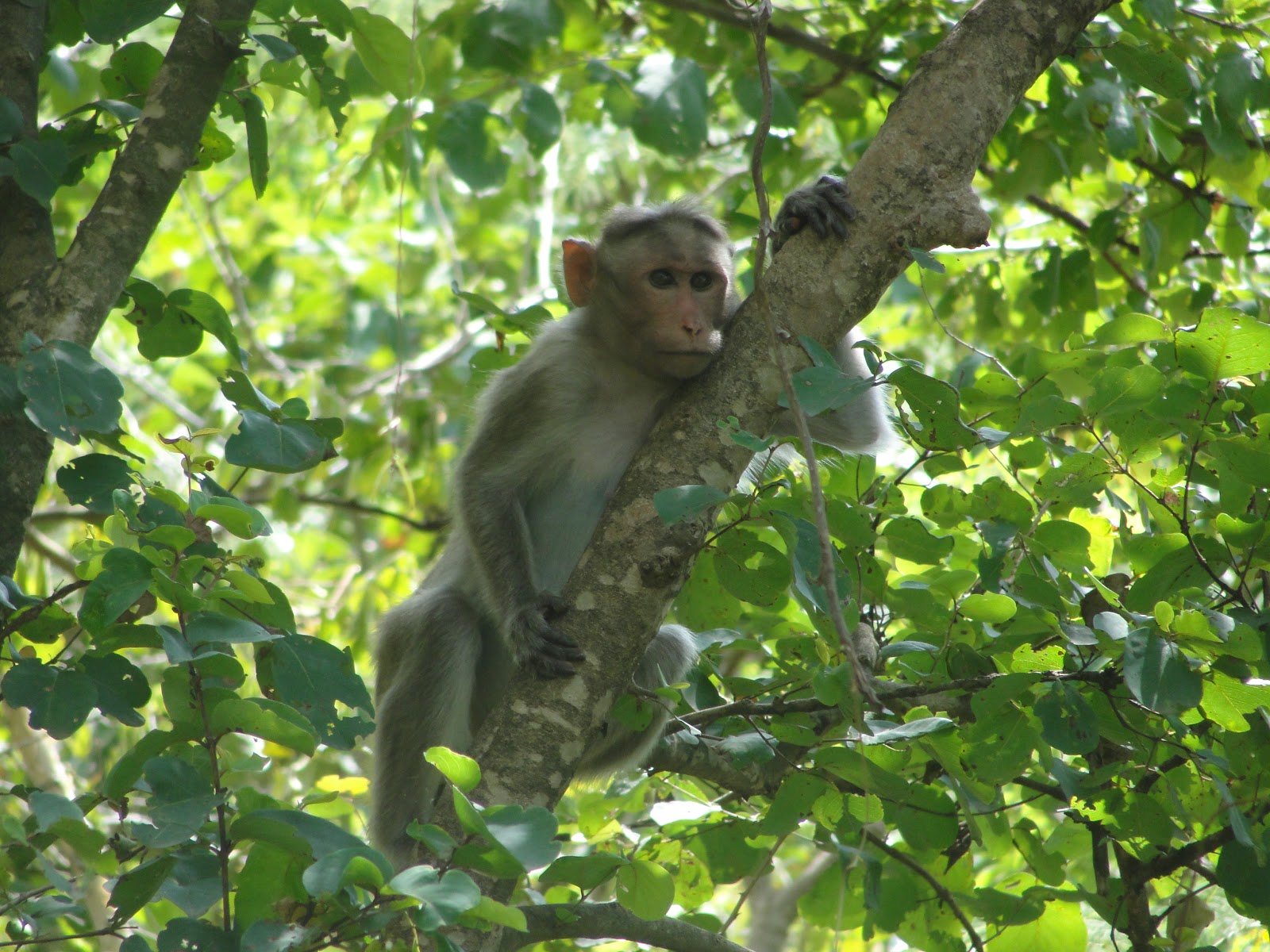
There are many monkeys at the hillock, so watch out. The roads are steep and curvy so drive safe.

Photos:

 The Bhoga Narasimha Temple
                                                              
Top view
 

My Companion
Top view from the hill
                                   

Curvy roads

Deer Reserve @ namada chilume


Namada Chilume water flowing from the mid of stone


The carving on Basava